

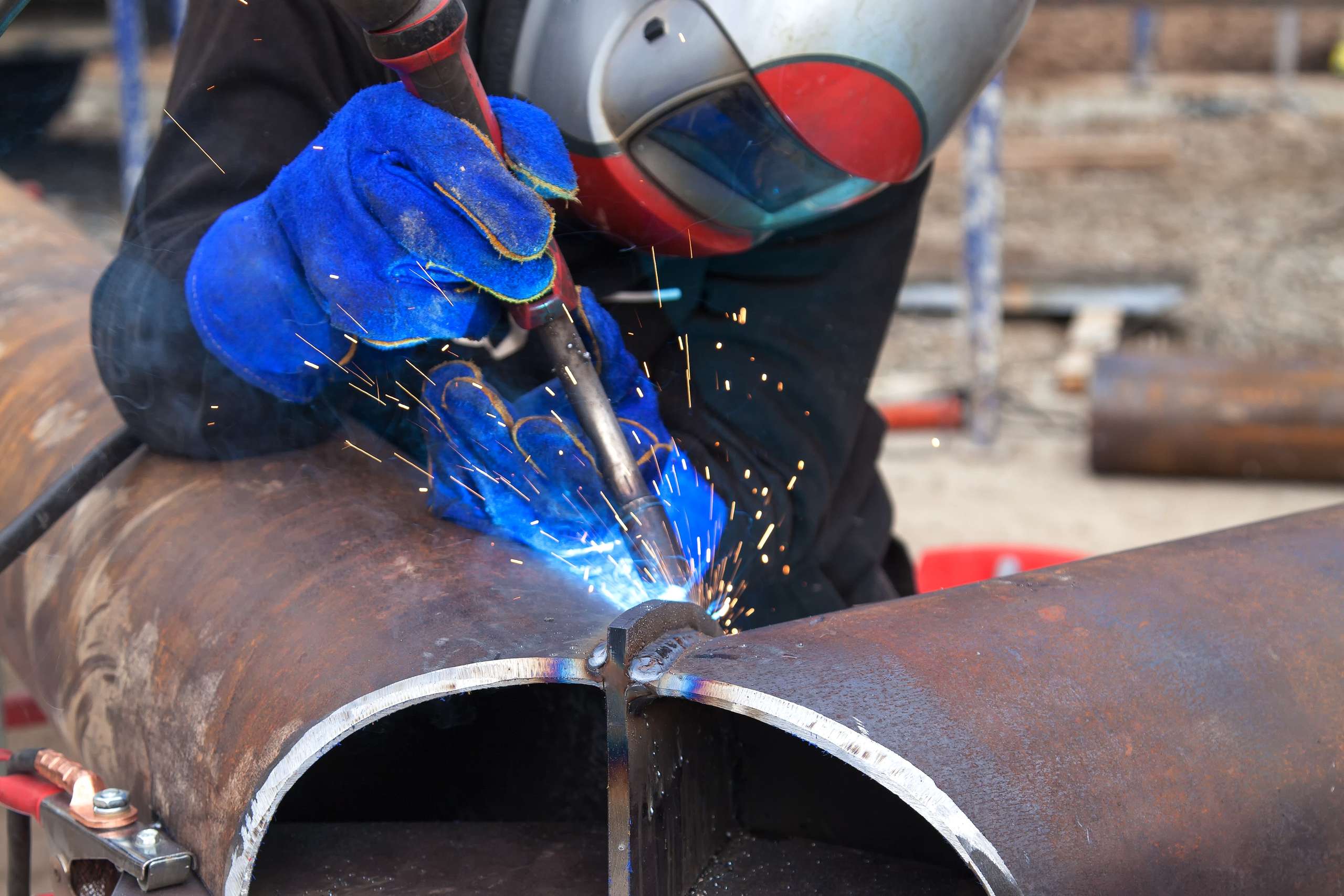
Perhaps the first thing you’ll notice after you get a good arc going is that your weld bead is not uniform. It might sag or run off to the side, or bulge up in some areas. This can be maddening, because your arc seems stable, but the weld isn’t. Many people suspect that there is some kind of adjustment on the welder that needs to be tweaked, but in most cases, the solution is in the way you’re moving. If your hands are not supported, every movement of your body is going to be transferred to the electrode or torch. By hooking your forearm or wrist over the edge of your work, you’re going to create a pivot point that will allow you to move steadily.
A second common cause is swinging the arm rather than moving the finger and wrist. Big joints make big arcs that are difficult to control once the arc is underway. Experiment with holding the gun as if writing with a large felt pen, slowly, and making small adjustments rather than big arcs. When the joint is long, move your body rather than trying to stretch to the other end of the joint. If you stretch, you will be tense. If you are tense, you will weave the bead or, worse, rush it at the end of the joint as you relax.
This is important for cosmetics as well. When the metal gets too hot, the puddle gets larger and the bead gets flatter even though the travel speed is still the same. Many novices take this as a good thing and keep going without lowering the heat, and their weld ends up as a squished, ugly bead. If you let the weld sit for a few seconds between passes, or if you move over to a different part of the metal, the temperature will stay constant. Pay attention to the puddle size as an indicator of increasing temperature rather than the brightness of the arc.
A little practice every day will change the way you control the muscle. Do some straight line practice where you run a bead along a line drawn on a piece of metal, maybe only moving a few centimeters at a time, inspecting the bead, then starting again. You want as many little uniform beads as possible. If you notice your bead wandering, don’t try to jerk the gun back on track, this will leave an ugly zig in your bead, instead, try to ease back on track, this will leave a uniform curve. With practice, your hand will learn how fast you need to move the gun to keep the puddle moving along in a straight line.
You’ve probably noticed that this can become a source of aggravation when you are having trouble getting improvement in your bead, but the irregularities in the bead tend to disappear once you’ve got your stance, support and travel speed figured out. In welding, it’s less important to hold a steady hand and more important to eliminate all extraneous movement. By eliminating the big movements and concentrating on small movements, you can allow your bead to go from a wandering trail of blood clots to a steady, continuous raised line that indicates consistent heat and travel speed.